
Safety Progress Signals a Stronger Future for Mining
There’s a clear and encouraging trend emerging across the U.S. mining industry: safety is at an all-time high. New data from the U.S. Department of Labor’s Mine Safety and Health Administration (MSHA) shows that the industry’s total recordable injury rate in 2025 fell to its lowest recorded rate, dropping to 1.74 per 200,000 hours worked from 1.82 the previous year. Behind that number is a story of commitment, collaboration, innovation and continuous improvement.
The all-injury rate, a key benchmark for mining safety, reflects the number of reportable injuries relative to hours worked, including everything from minor medical incidents to fatalities. An all-time low for this rate is not accidental. It is the result of sustained effort across the industry and government to prioritize worker protection while meeting the nation’s growing demand for energy and materials.
Acting Secretary of Labor Keith Sonderling noted that, “these historic safety numbers demonstrate that the Trump Administration’s efforts to revitalize America’s mining industry are being met with a parallel commitment to worker protection.”
“Keeping miners safe is our top priority, and seeing the rate of injuries decrease is cause for celebration,” added Assistant Secretary for Mine Safety and Health Wayne Palmer.
An Alliance for Improvement
Just last week, Palmer and Rich Nolan, the National Mining Association’s (NMA) president and CEO, formerly renewed the MSHA-NMA Alliance Agreement, continuing a long-standing partnership focused on improving safety and health across the nation’s mining operations.
The long-standing collaboration between MSHA and the NMA focuses on expanding training and education, analyzing injury trends, sharing best practices and enhancing emergency response capabilities. By working together, MSHA and the NMA are helping ensure that miners have access to the tools, knowledge and systems needed to reduce risks and return home safely at the end of every shift.
Industry’s Commitment
Reducing injury rates takes commitment and collaboration. And while it’s important to celebrate progress, the goal is zero fatalities and injuries. To get there, the industry goes well beyond what is required by regulations.
The industry’s own initiative, CORESafety®, developed and led by NMA and its members, is an award-winning safety framework that provides a proactive, systems-based approach to safety. As the MSHA data reflects, CORESafety® and the industry’s commitment to safety are producing results. Not only has the mining injury rate dropped to its lowest level ever but mining also has a lower nonfatal injury and illness record than manufacturing, construction or private industry. In the past 15 years, mining injuries have fallen by 40% and fatalities by 70%. These gains are significant, but the industry is not standing still. Continuous improvement remains the industry’s north star.
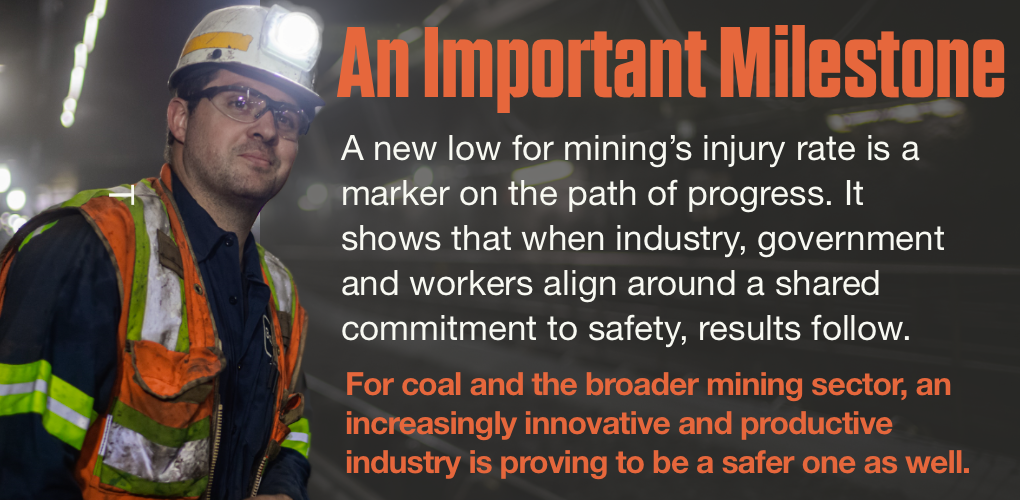
A new low for mining’s injury rate is an important milestone and a marker on the path of progress. It shows that when industry, government and workers align around a shared commitment to safety, results follow. For coal and the broader mining sector, an increasingly innovative and productive industry is proving to be a safer one as well.
- On May 6, 2026