
The Electricity Demand Story Everyone Is Missing
The world is using more electricity than ever. Global power demand reached a record high in 2025, growing at more than twice the rate of overall energy demand.
But the single largest driver of that growth isn’t artificial intelligence, data centers or electric vehicles. It’s air conditioning.
Speaking at an oil and gas conference in Stavanger, Norway, this week, International Energy Agency Executive Director Fatih Birol called air conditioning “the single most important driver” of global electricity consumption growth.
As incomes rise across the developing world, hundreds of millions of people are gaining access to cooling. Since 2015, global electricity consumption for air conditioning has increased by 50%—an increase equal to the total annual electricity consumption of the entire European Union.
And the cooling boom is just getting started.
Annual air-conditioner shipments are 25% higher than they were five years ago, driven largely by growth in emerging and developing economies. Yet only about 40% of the global population has access to air conditioning, even though more than 80% experiences temperatures requiring cooling during at least part of the year.
Air-conditioner ownership in India and Southeast Asia remains far below levels in Japan and the United States. As that gap closes, cooling will remain one of the largest – if not the largest – drivers of global power demand for years to come.
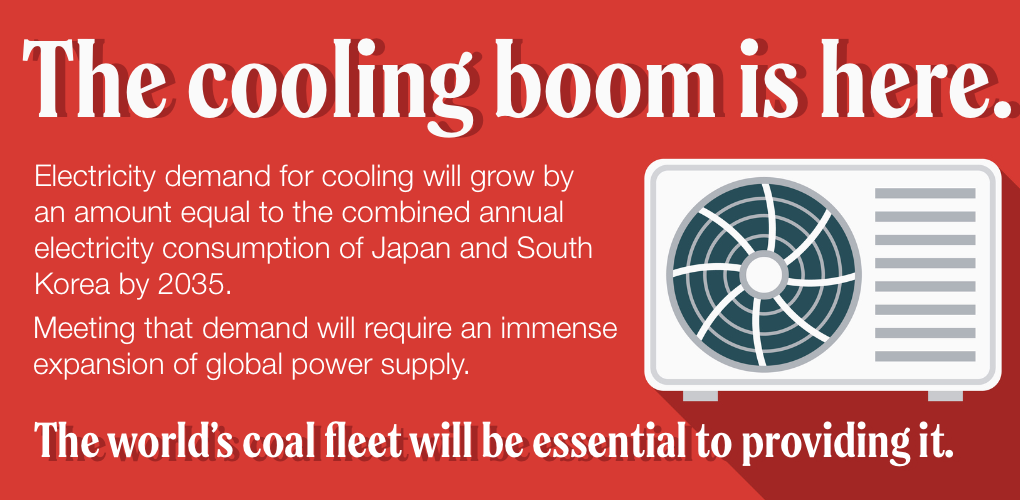
The IEA projects that electricity demand for cooling will grow by an amount equal to the combined annual electricity consumption of Japan and South Korea by 2035. Meeting that demand, alongside soaring consumption from data centers, electric vehicles and industrial development, will require an immense expansion of global power supply.
The world’s coal fleet will be essential to providing it.
Soaring Demand Meets Growing Energy Insecurity
This surge in electricity demand is arriving just as conflict in the Middle East has placed renewed pressure on global energy markets and elevated the importance of energy security.
Birol believes the turmoil will fundamentally reshape energy planning. “‘Just in time’ will be replaced by ‘just in case,’” he said, predicting the emergence of “a new energy map.”
Renewable energy has received a boost as countries seek to reduce their exposure to disrupted oil and natural gas supplies. But so has coal—particularly in emerging economies that need affordable, dependable power and remain vulnerable to volatile liquefied natural gas prices.
Patrick Pouyanné, CEO of French oil and gas giant TotalEnergies, recently warned that emerging nations are “losing trust” in LNG following two successive price shocks. The result, he said, is simple: “Back to coal.”
Coal, after all, remains the undisputed leader in global electricity generation. The IEA expects coal plants to produce 10,974 terawatt-hours of electricity in 2026—nearly one-third of global generation. That is 77% more electricity than wind and solar combined and far ahead of natural gas, coal’s closest competitor.
And the global coal fleet continues to expand. China has roughly 500 gigawatts of coal capacity in the development pipeline and India is planning 100 GW of new coal capacity in just the next seven years. Across the globe, there is new recognition that rapidly rising electricity demand requires generating capacity that is not only affordable but available whenever it is needed.
The global electricity conversation may be dominated by AI and data centers, but billions of people seeking something Americans have long taken for granted – relief from the heat – could prove even more consequential.
As the world grows richer and electricity demand accelerates, coal will remain irreplaceable to securely, reliably and affordably meeting global energy needs.
- On August 26, 2026