
A Repeal Just in the Nick of Time
Today in Houston, U.S. Environmental Protection Agency (EPA) Administrator Lee Zeldin brought reason back to EPA regulation and repealed the prior administration’s unworkable and unlawful carbon rules for new and existing power plants.
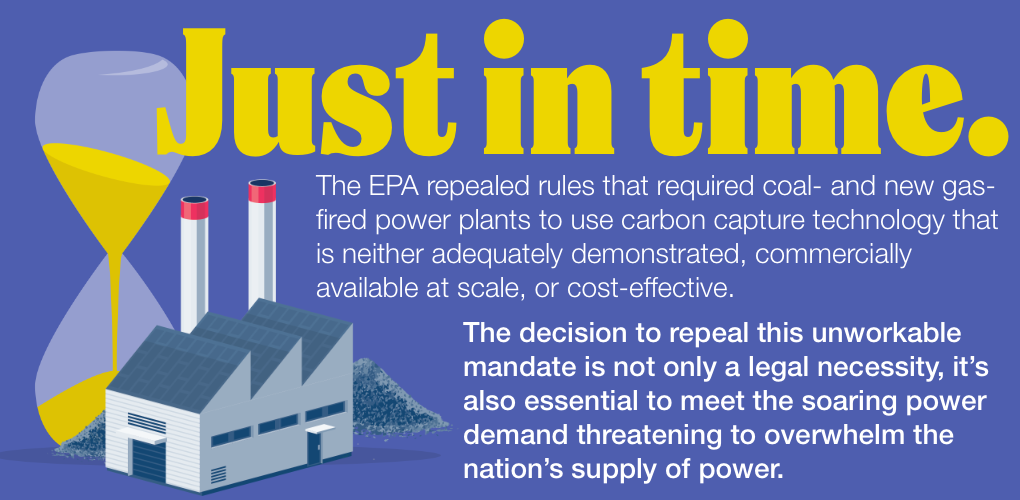
Today’s action repealed rules that required coal- and new gas-fired power plants to use carbon capture technology that is neither adequately demonstrated, commercially available at scale, or cost-effective.
“Through decisive and sound policymaking, based on real life energy demands and grid realities, this administration has averted what would have been a catastrophic collision of unlawful and unworkable Biden-era technology mandates with surging energy demands,” said Rich Nolan, National Mining Association President and CEO.
“With today’s repeal, well-operating coal plants are no longer faced with the false choice between commercially unavailable and technically infeasible technologies, fuel-switching or closure. The administration’s action corrects the egregious misuse of the Clean Air Act as a political tool to end American coal generation and implements the law as Congress intended,” Nolan added.
The prior administration’s carbon capture mandate was a thinly veiled attempt to simply close plants. Mandating carbon capture and storage at the nation’s coal plants and new natural gas plants, and claiming, as Section 111 of the Clean Air Act requires, that it’s “adequately demonstrated” technology was both laughable and unlawful. When the Regan EPA authored the rules, there was not a single coal plant in the world capturing carbon at the level EPA mandated. That remains true today.
The decision to repeal this unworkable mandate is not only a legal necessity, it’s also essential to meet the soaring power demand threatening to overwhelm the nation’s supply of power.
A New Era of Soaring Demand
Utilities and grid operators are forecasting the strongest period of electricity demand growth in decades. The nation’s grid watchdog now expects summer peak demand and winter peak demand to jump by over 225 gigawatts (GW) and 245 GW, respectively, over the next decade—enough electricity to power 150 million homes. Meeting that demand – and doing so affordably – without the coal fleet would be all but impossible. It’s a reality Americans recognize.
In fact, new national polling conducted by The Harris Poll on behalf of the NMA found 58% of Americans support the U.S. government taking action to keep coal plants open to maintain electricity reliability and affordability until replacement capacity is built and online; only 18% oppose. Those resounding results not only demonstrate growing public concern about electricity reliability and affordability but also growing awareness of the importance of coal to the nation’s power supply.
With power demand surging and growing concern that the U.S. may face rising natural gas prices in the years ahead, providing the coal fleet the opportunity to compete in the marketplace isn’t just sound policy, it might well provide the grid reliability backstop and price shock absorber we’re going to need more than ever.
- On September 14, 2026