
Voters Want Affordable Energy. Coal Is Part of the Answer
Affordability was on the ballot Tuesday, with few issues more important than energy. Americans are deeply frustrated with rising prices. An October poll from the Pew Research Center found that 74% of U.S. adults were concerned about the price of gasoline and energy, the largest share of concern among all surveyed issues.
While much of the focus on energy prices will understandably zero in on the price at the gas pump, don’t overlook voter concern with electricity prices. National average electricity prices have increased about 10% in the last two years and 40% since 2020. A recent poll from Hart Research found that voters in battleground districts ranked utility bills among the three most important issues in the midterms.
In September, the Harris Poll conducted national polling on behalf of the National Mining Association and found both deep concern over electricity affordability and strong support to utilize the coal fleet to keep prices in check. Fifty-eight percent of Americans supported the U.S. government making efforts to keep coal plants open to maintain electricity reliability and affordability until replacement capacity is built and online; only 18% opposed.
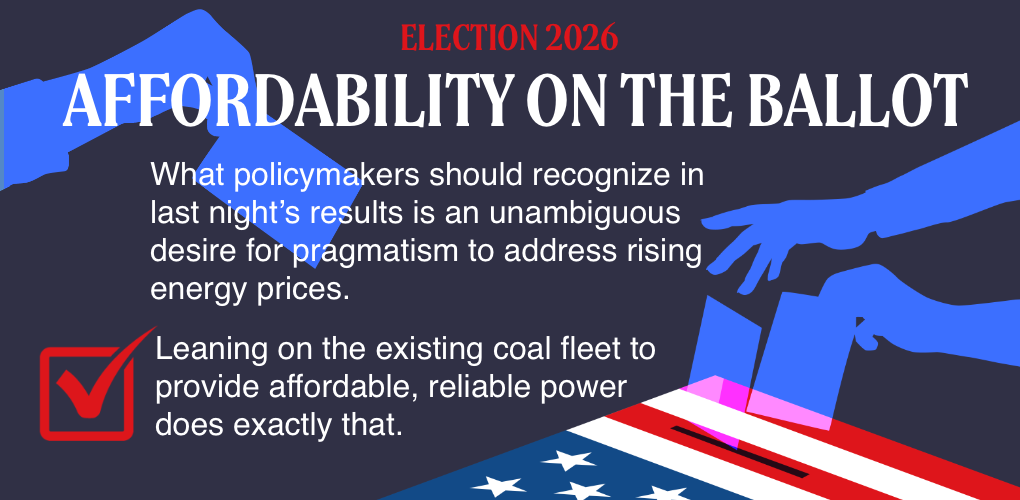
What policymakers should recognize in last night’s results – and the months of polling that preceding them – is unambiguous desire for pragmatism to address unsustainable costs. Leaning on the existing coal fleet to provide affordable, reliable power does exactly that.
Americans understand that power plants already online today – that surge power when needed – are a bulwark of keeping prices in check as the cost of new capacity continues to rise and as power demand soars.
The optionality provided by the coal fleet also underpins affordability when prices spike. As we saw in 2025, when natural gas prices jumped, coal generation came to the rescue, shielding consumers from higher natural gas prices and reducing utility bills. Economic analysis found that increased coal generation delivered an estimated $30 to $40 billion in combined power-sector and natural gas savings. That optionality – that price shock-absorber – will only be more valuable in the years ahead.
America is dealing with one energy shock at the moment, but it could easily be two. Remarkably, while domestic gasoline and diesel prices have soared, domestic natural gas prices have not. In Europe and Asia, where imported LNG dictates prices, the cost of natural gas is 12 times higher. Nations from Germany to South Korea will be leaning on coal this winter to keep the lights on and to keep prices from crushing consumers.
With U.S. natural gas demand growing so rapidly, and U.S. LNG export capacity on the verge of doubling, could domestic prices begin to drift towards their far higher benchmarks in Europe and Asia? One forecast after another sees U.S. natural gas prices rising in the years ahead. With natural gas the leading fuel for both U.S. electricity generation and home heating, even a small increase in prices will have tremendous impacts across the economy. Preserving and even investing in dispatchable fuel optionality should be a foundational piece of any affordability agenda.
- On November 4, 2026