
Global Coal Investment is Rising and a New Energy Security Playbook is Emerging
Has the Iran energy crisis driven new demand for coal? Certainly. But as the International Energy Agency (IEA) reveals in a new report on global energy investment, coal was already very much in demand. The war with Iran and its energy disruptions have only supercharged it.
According to the IEA, investments in coal have reached a 14-year high and are set to top $180 billion by the close of 2026. China and India are leading the investment charge, with China alone spending $100 billion on coal this year, double what it invested in the sector a decade ago. India, the world’s second largest investor in coal, has seen its investments triple in the past decade.
Coal investment is growing and diversifying. Coal remains the world’s leading fuel for electricity generation, is essential to steel and cement production, and is increasingly being utilized as an alternative to oil and natural gas as a feedstock for fertilizer, petrochemical and liquid fuel production. And notably, as the IEA’s report highlights, capital flows to new coal generating capacity are rising as well.
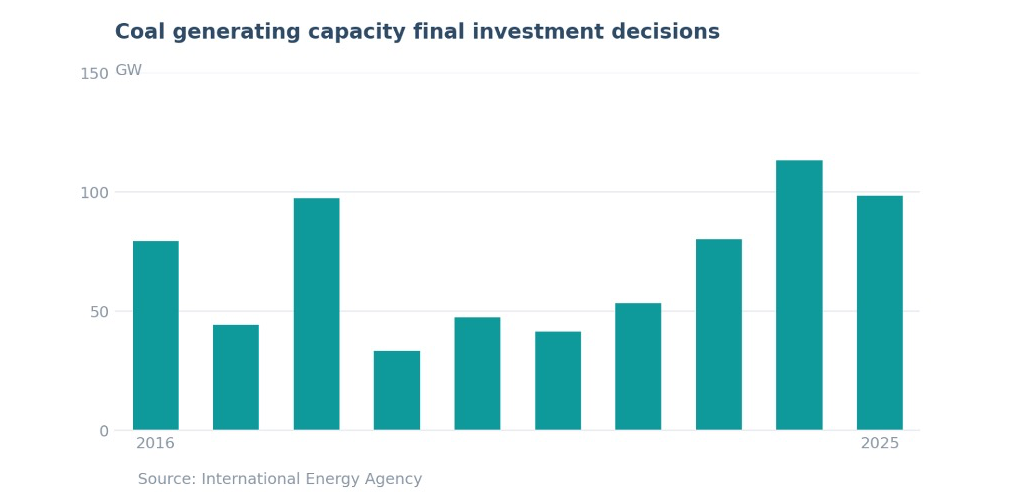
The IEA’s findings match recent analysis from the Global Energy Monitor which found coal power capacity grew 3.5% in 2025 with 32 countries proposing to or already building new coal plants. China and India – not surprisingly – dominated global coal capacity additions.
Alongside its enormous renewable energy buildout, China now has more than 500 gigawatts of coal-fired capacity in development, nearly twice the size of the existing U.S. coal fleet.
A Shift Towards Security, Trust and Diversity
China’s coal security blanket has proven a significant advantage during the current energy crisis—an advantage that has not gone unnoticed by developing economies.
Even if the current agreement with Iran holds and energy trade from the Gulf starts to flow again, don’t expect a sudden return to the global energy trade patterns that came before.
“Confidence in the reliability of transit through the Strait of Hormuz has been profoundly shaken,” the IEA said in its recent energy investment report.
“Globally, the conflict is reinforcing a shift towards security, trust and diversity as key considerations when choosing energy projects and partners…. This will have wide-ranging implications for the fuels and technologies that countries prioritize, where they get them from, and how they look to achieve other strategic energy objectives,” the IEA said.
With trust in the global gas trade shaken, coal has become a deeply attractive hedge against insecurity and market volatility.
Will this energy shock have long-term impacts on energy trade flows and even consumer habits? Time will tell, but it’s not far-fetched to see consumers and governments lean into hybrid and fully electric vehicles, renewable energy, and the security afforded by coal.
That may seem like an unconventional – even odd – combination, but it’s exactly the approach China has taken. And China, more than any other nation, has emerged from this crisis as an energy winner. No one should be surprised if the China model – built on a foundation provided by coal – becomes the energy security playbook.
- On June 17, 2026