
Grid Operators Tell the Court: EPA’s Rule is a Dire Threat to Reliability
The nation’s grid operators warned the U.S. Environmental Protection Agency (EPA) that the then proposed so-called Clean Power Plan 2.0 was a direct and alarming threat to grid reliability. Those concerns were shrugged off as EPA pushed forward and finalized an unworkable and unlawful rule. Now, the grid operators are getting involved in the legal fight to stop it.
Four of the nation’s largest grid operators, led by the Midcontinent Independent System Operator (MISO), filed a joint “friend of the court” brief urging the U.S. Court of Appeals for the District of Columbia Circuit to send EPA back to work on a rule that simply won’t work.
MISO was also joined by PJM Interconnection, Southwest Power Pool and the Electric Reliability Council of Texas, which together account for ensuring electric reliability for 30 states and the District of Columbia.
In their brief, the operators explained that “Such inevitable and foreseeable premature retirement decisions resulting from the Rule’s timelines will substantially strain each of the [grid operators’] ability to maintain the reliability of the electric power grid to meet the needs of the citizenry and the country’s economy.”
They added, “The Final Rule unreasonably discounts that existing fossil power generators will need to decide whether to commit to installing untested technology or retire the generating unit years before the compliance deadline, given the economic cost and risk of compliance.”
Coal Fleet Remains Essential
The grid operators are doubling down on the importance of the existing coal and gas power plant fleets and are underscoring what we have known all along: EPA’s rule is a thinly veiled plan to close plants that are desperately needed.
What the grid operators are specifically referring to with untested technology is the mandate to install carbon capture and storage technology at existing plants with a 90% capture rate. As industry, the nation’s leading carbon capture experts and even the nation’s reliability regulators have highlighted, there isn’t a commercial power plant in the world achieving a 90% capture rate.
Federal Energy Regulatory Commissioner recently told Congress that, “The overwhelming weight of the expert evidence indicates that a 90% carbon capture standard applied to generation units fueled by gas or coal is neither technically nor commercially feasible. I am not aware of any generating units that are commercially successful in energy or capacity markets today that have met such an unrealistic standard.”
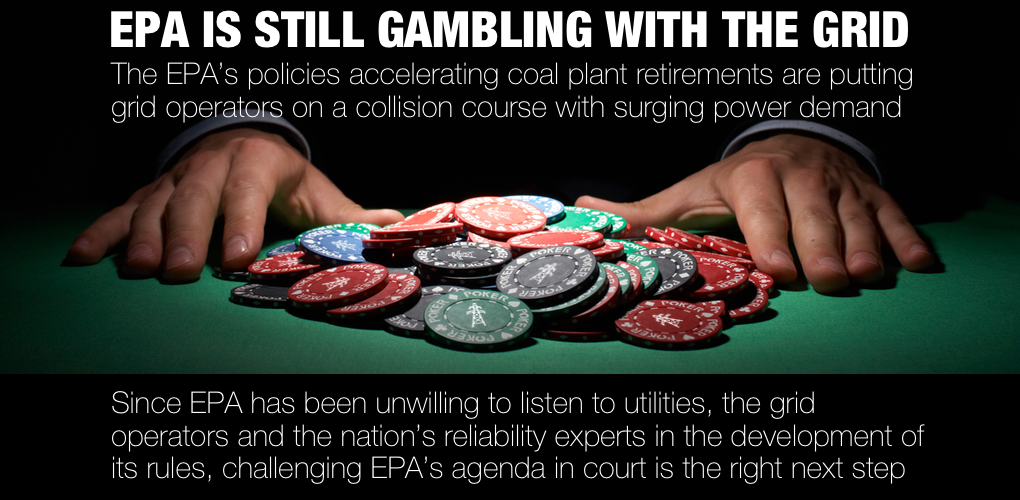
The grid operators recognize EPA has set accelerating plant retirements on a collision course with surging power demand that almost certainly can’t be met by renewable additions alone.
Consider a recent warning from MISO. In June, MISO said that if its members don’t delay retirements of power plants – under threat from EPA – or bring more resources online faster and at larger numbers than they have historically, a potential 2.7-gigawatt (GW) deficit in capacity next year could soar to 14 GW in 2029. A deficit equivalent to being short the power needed for 10 million homes.
The stakes are enormous. Since EPA has been unwilling to listen to utilities, the grid operators and the nation’s reliability experts in the development of its rules, challenging EPA’s agenda in court is the right next step. After all, if there’s one thing history tells us, EPA understands a mandate.
- On September 18, 2024