
Germany’s Coal Phase-Out Meets Energy Reality
Germany’s coal phase-out, or kohleausstieg, is colliding with energy reality.
This August, the German government is expected to publish a review of the coal phase-out, including its impact on energy supply, security and prices. Once envisioned as a report that could justify accelerating the coal exit, Germany’s current energy situation may instead make the case for slowing it down.
Germany remains Europe’s largest user of coal for power generation – meeting roughly 20% of power demand – even as it has pledged to stop using coal altogether by 2038 in favor of even greater reliance on wind and solar power.
But Germany’s well-documented struggles with dunkelflaute — the “dark doldrums” when wind and solar output collapse — have reinforced the need for reliable, dispatchable backup power. A move further away from coal would not mean greater reliance on renewables—it would mean greater reliance on natural gas. And that is precisely the risk Germany is now being forced to reconsider.
Energy Security Is Rewriting the Debate
Germany is navigating its second natural gas shock in four years following Russia’s invasion of Ukraine and the U.S.-Israel war with Iran. Deepening exposure to gas price volatility while retiring dispatchable coal capacity is increasingly difficult to defend, especially for an industrial economy already struggling with exorbitant power prices.
Germany has watched neighbors and other major industrial powers lean on coal as a hedge against energy insecurity and unaffordable power. Italy and Japan have done so in just the past few months. With German electricity prices already far above the European average, momentum is building inside Germany for a policy reset.
In March, German Chancellor Friedrich Merz said, “We must supply this country with electricity. I am not prepared to jeopardize the core of our industry simply because we have adopted phase-out plans that have become unrealistic.”
Michael Kretschmer, deputy leader of Germany’s center-right ruling coalition and Minister-President of Saxony, went further: “Germany, as a major industrial nation, must do everything in its power to ensure that energy remains affordable. The energy transition must be completely recalculated. It should not be a matter of cost, but rather a matter of realistically considering security of supply and affordability.”
Coal as an Affordability and Security Salve
If Germany decides to slow or halt its coal phase-down, it will be moving with, not against, the global trend.
A recent Global Energy Monitor report found that nearly 70% of coal plants scheduled to retire in 2025 did not do so, including 69% of scheduled retirements in the European Union and 59% in the United States. The U.S. Energy Information Administration in fact observed that 2025 saw U.S. coal plant retirements fall to their lowest level in 15 years.
Much has been made of the Trump administration’s efforts to support coal—but the Trump administration hasn’t caused what is now a global shift back to coal. Energy demand and energy realities have.
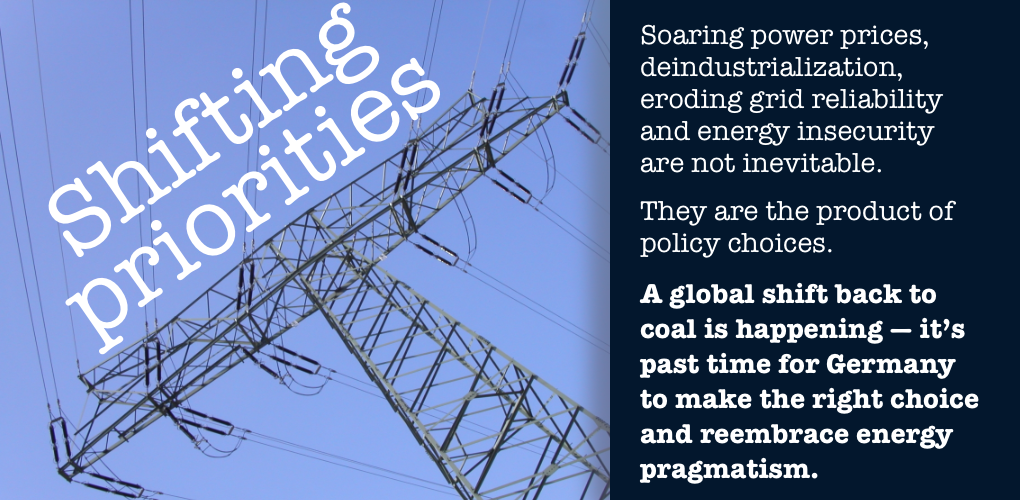
The German marketplace is now begging for more coal power, not less. Soaring power prices, deindustrialization, eroding grid reliability and energy insecurity are not inevitable. They are the product of policy choices. It’s past time for Germany to make the right choice and reembrace energy pragmatism.
- On June 24, 2026