
The Natural Gas Price Squeeze is Coming, Coal Offers a Critical Safety Valve
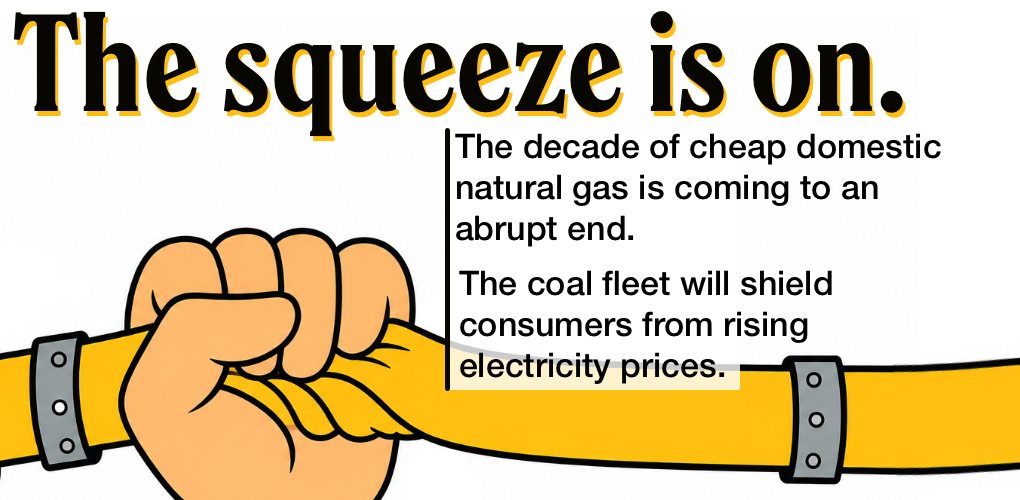
The decade of cheap domestic natural gas is coming to an abrupt end. So say analyses from Wood Mackenzie and Bloomberg New Energy Finance (BNEF), a conclusion that holds huge implications for our energy policy, consumers and the nation’s economic competitiveness.
Wood Mackenzie forecasts Henry Hub natural gas prices, the domestic benchmark, will approach $5 per million BTUs by 2035, up from the range of $2 to $4 that characterized prices for the past decade. These extraordinarily low prices propelled natural gas to become the nation’s leading fuel for electricity generation, incentivized a rush for gas to power the AI and datacenter revolution, and turned the U.S. into the world’s largest LNG exporter. But these same low prices have now created sustained structural demand as supply becomes both more challenging and more expensive to grow.
“Rapid play development, near-zero-cost associated gas, and year-on-year productivity gains drove that era of cheap, stable prices. Those tail winds have largely run their course,” the report’s authors observed. “Prices will need to rise to grow supply from here.”
And as supply stalls, new demand is arriving at a stunning level. Wood Mackenzie sees 17 billion cubic feet per day of new natural gas demand coming from the power sector alone by the mid-2030s, roughly half the gas demand of the entire existing power sector. If not enough, U.S. LNG capacity is on track to more than double from current levels. The U.S. will account for more than one-third of global LNG supply by the early 2030s.
The Data Center Goliath
BNEF sees similar dynamics driving a rise in natural gas prices. Surging demand needed to power data centers and supply LNG exports could mean U.S. demand exceeds supply as soon as 2028, according to their analysis.
The scale of coming data center power demand is much debated but is largely now falling into two camps: enormous and mind-boggling. In a base case, BNEF sees 118 GW of data center demand in 2030 and 194 GW by 2035, an upward revision of 52% and 83% from its last forecast released just seven months ago.
A second even more bullish BNEF forecast, developed around expected AI chip deliveries, sees 207 GW of U.S. data center demand by 2033—that would be significantly more demand than the peak demand of PJM Interconnection, the nation’s largest electricity market serving 67 million Americans.
The BNEF authors observe that, “In our pipeline now, we have over 70 projects that are a gigawatt in size, and even some projects that are multiple gigawatts, up to 10 GW.” Each of these projects – even on the lower end – has the power needs of a mid-size city. On the higher end, these projects have power needs that eclipse the peak demand of New York.
Coal as Price Shock Absorber
The key question now is where is the U.S. going to get the power to meet soaring demand and do so affordably in a gas-constrained environment? Enter the coal fleet.
The Department of the Interior last week released a new report showing that there’s at least 600 years of coal at current consumption rates on federally managed public lands. That’s good news because the coal fleet – and our abundant coal reserves – are the nation’s irreplaceable price shock absorber. When natural gas prices rise, the fleet has the spare capacity to run at a higher capacity factor, reducing gas demand and surging power where needed. It’s a critical tool to both maintain grid reliability and soften the blow of natural gas price spikes.
For every $1 increase in the Henry Hub natural gas price, U.S. consumers and manufacturers pay approximately $54 billion annually in combined extra expenses, according to the Industrial Energy Consumers of America.
Shielding consumers from rising natural gas prices is exactly what the coal fleet did in 2025. When wholesale natural gas prices jumped 56% last year, the optionality provided by coal generation helped save consumers an estimated $30-40 billion in energy costs. Utilities were able to turn to coal as a lower cost option and reduce their natural gas demand.
Investments to improve the performance of existing coal plants – and efforts to keep plants on the grid – are strategic investments in energy affordability. The coal fleet may well be the cavalry riding to the rescue if the forecasts of rising natural gas prices come true.
- On July 29, 2026