
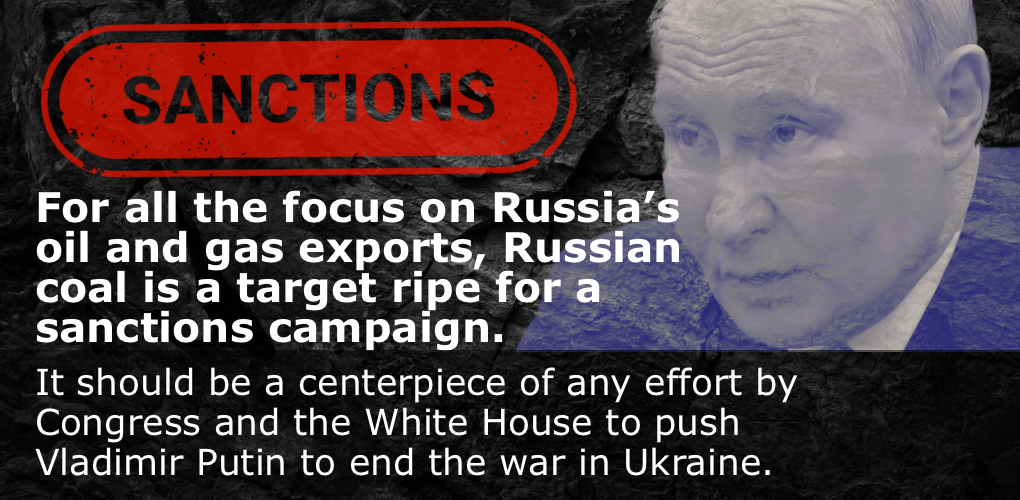
Use U.S. Coal to End Russia’s War in Ukraine
As President Trump sat with President Zelensky on the sidelines of the NATO summit earlier today, it was clear the U.S. is engaged in the pursuit of peace between Russia and Ukraine, and willing to offer its assistance. While President Trump suggested new support in terms of air defense missiles may be on the table, there remains one powerful financial weapon against Russia that the U.S. has yet to deploy: sanctions on Russian coal.
Ukraine is winning on the battlefield and wreaking havoc on Russian energy infrastructure with targeted drone and missile strikes. Russian crude oil production dropped 10% below May’s target according to recent analysis from the International Energy Agency. Long lines of Russian drivers seeking rationed fuel also underscore the impact of Ukrainian strikes on Russian refining capacity.
Momentum is building once again in the U.S. to end the war, and a bipartisan group of lawmakers is reviving efforts to pass legislation that could cripple Russia’s economy. The legislation would allow President Trump to impose sanctions and tariffs on any nations doing business with Moscow. Like Ukrainian drones, the legislation would take direct aim at Russian energy exports, the lifeblood of the Russian economy and Vladimir Putin’s war machine.
And for all the focus on Russia’s oil and gas exports, Russian coal is a target ripe for a sanctions campaign. It should be a centerpiece of any effort by Congress and the White House to push Vladimir Putin to the negotiating table.
An Economic Vulnerability
Russia’s coal export revenues were estimated at $19 billion last year. That’s a significant stream of foreign currency that has been used to bolster Russian offensives and pay for Iranian drones as well as foreign troops and equipment.
While Russia has had to reorient the market for its coal from west to east, and sell it at a discount, exports have grown since the start of the war and continue to grow today. Russian coal export revenues and volumes in fact grew 5% from April to May. Troublingly, while China is the largest destination for the Russian coal exports, several close U.S. allies and trade partners are major buyers – buyers that could and should be using U.S. coal instead.
From December 2022 until the end of May 2026, China purchased 37% of all Russian coal exports, India (19%), Turkey (15%), South Korea (12%), and Taiwan (4%) to round out the top five buyers’ list.
While Russian coal exports are generating significant revenue this is also an industry on the ropes. Russia’s coal sector, which employs nearly 150,000 people, has been under pressure and losing billions of dollars. Russian coal companies posted combined losses of 408 billion rubles ($5.47 billion) in 2025, with nearly 70% of firms operating at a loss.
Targeted sanctions could push the Russian coal sector off the precipice and fully into collapse sending shockwaves throughout the Russian economy and creating a political problem that would carry significance far greater than the sector’s economic weight.
Symbolic Impact
As the Financial Times observed last fall, the coal industry and miners’ strikes carry symbolic weight in Russia. In 1989, miners’ strikes swept across the Soviet Union, marking a critical moment in its collapse. And Miners banging their hard hats on Moscow’s cobblestones also became a symbol of Russia’s 1998 economic crisis, the worst in the nation’s modern history.
Can the U.S. force a repeat of those miner protests and once again fill the Kremlin with the sound of miners’ helmets echoing off cobblestones?
The U.S. sanctions legislation has almost unprecedented bipartisan support. When it was introduced in 2025 by Sens. Lindsey Graham (R., S.C.) and Richard Blumenthal (D., Conn.), it had 80 cosponsors in the Senate. What it has lacked so far is support from President Trump. That could be changing.
Now is the moment to deal a decisive blow to the Russian economy and use American coal to help do it. The war in Ukraine has gone on for far too long. What is now painfully clear is that Vladimir Putin won’t seriously negotiate for peace unless he’s dragged to the table. Crippling Russian energy revenues, including those from coal, can finally force the issue.
- On July 8, 2026