
The Race for Power Leads Back to Coal
As demand for electricity from AI data centers soars, the data center industry has already indirectly been relying on the coal fleet to meet their soaring power needs. Now, data companies are getting directly into the game, contracting for power from coal plants and even trying to buy coal units.
Utilities too aren’t just delaying or outright cancelling coal plant retirements— they’re now working with the Trump administration to invest in these assets and ensure they can ramp up power for the demand surge to come. The administration is working with two dozen plant owners to upgrade units, bring a plant back online and potentially build two new coal plants.
A West Virginia Bidding War Reveals a National Trend
There was recently a bidding war in West Virginia between a data center developer and American Electric Power (AEP) for the 710-megawatt Longview coal plant. The Financial Times observed that the “bidding war underlines how coal has been brought in from the cold as US electricity demand soars.”
A notable shift is underway as rising demand collides with bottlenecks to get new generating resources on the grid. The existing coal fleet has rapidly emerged as critically important dispatchable capacity—capacity that is available today and capable of ramping up utilization rates to meet additional demand.
There are a range of estimates on just how much U.S. power demand is poised to grow, but projections for data center additions continue to balloon. A recent Bloomberg New Energy Finance base case forecast sees 118 GW of data center demand in 2030 and 194 GW by 2035, an upward revision of 52% and 83% from its last forecast released in January.
AEP says it bought Longview to serve surging demand in PJM, the nation’s largest electricity market and home to the so-called data center alley in Northern Virginia. Since 2024, capacity prices in PJM have jumped by more than 1,000% due to demand far outpacing available supply. Despite once again hitting a price cap in the latest capacity auction, PJM fell short of its reliability requirements, meaning it is at alarming risk of electricity shortfalls. Getting more power into the PJM market – and ensuring existing capacity doesn’t leave – is now a policy priority that reaches all the way to the White House.
Coal Capacity Is the New Data Center Prize
While some states are balking at the growth of data center demand and putting moratoriums on data center development, other states are jumping at what they see as a once-in-a-generation opportunity. Governor Patrick Morrisey of West Virginia has pledged to triple the state’s electricity generation capacity to 50 GW by 2050. Not only would he like to attract data centers to his state but wants to capitalize on the ongoing data center boom in neighboring Virginia.
If coal plants were once gigawatts of capacity hiding in plain sight, the secret is out. Along with the bidding war in West Virginia, a recent power purchase agreement in Indiana that is built around coal generation underscores the new reality.
Amazon and Google data centers signed a contract in May to purchase a pooled blend of power from NIPSCO Generation that is underpinned by coal power. The Merom coal power plant was set to close in 2023 but was kept running to meet rising demand. Now the plant will provide power through 2040 as part of the data center deal.
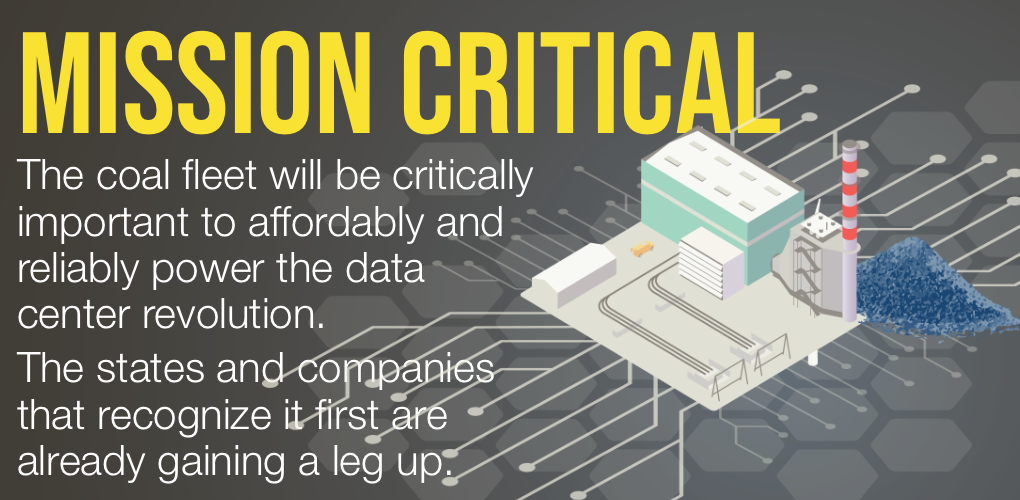
There’s good reason to believe the bidding war in West Virginia for Longview and the new power purchase agreement in Indiana are early signals of an emerging trend: the coal fleet will be critically important to affordably and reliably power the data center revolution. The states and companies that recognize it first are already gaining a leg up.
- On August 5, 2026