
Coal to the Rescue: Geopolitics and Rising Electricity Demand Require American Coal
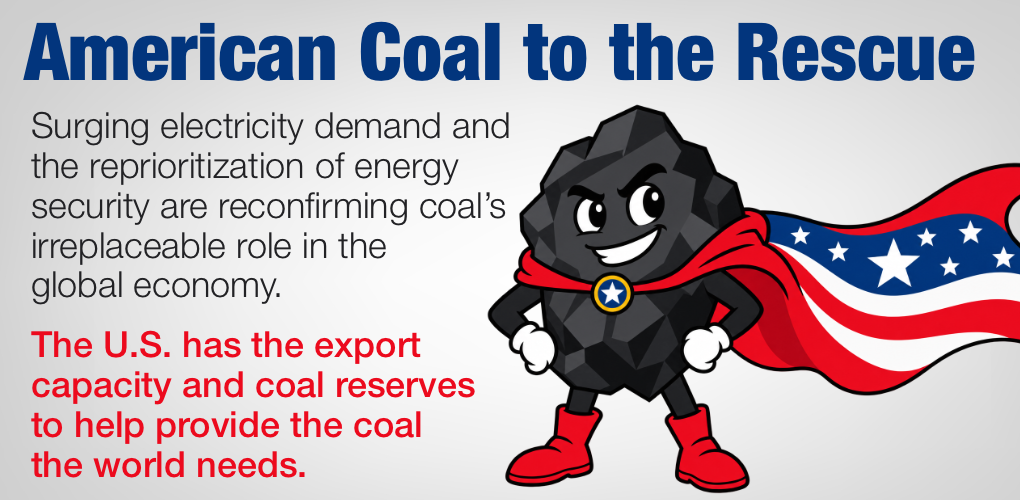
Surging electricity demand and the reprioritization of energy security are reconfirming coal’s irreplaceable role in the global economy.
Global electricity demand is soaring from industrial expansion, electric vehicle deployment, rapid uptake of air conditioning and data center rollouts, among other factors. And as demand soars, so does the need for secure, reliable energy, with the Iran conflict continuing to disrupt global energy markets.
According to the IEA’s report, Electricity Mid-Year Update 2026, global electricity demand is set to grow by a robust 3.6% in 2026 and accelerate further to 3.8% in 2027, up from 3% in 2025. This year-on-year demand growth has seen global electricity consumption rates also hit new highs. Demand in China modestly increased, while India’s skyrocketed from 1.6% to 7% year-on-year. And after a decade of flat demand, electricity demand in the U.S. is growing steadily as well. This forecasted global electricity demand growth comes at a time of extreme uncertainty in both geopolitics and global energy price markets. Due to conflict in the Middle East, LNG prices have ranged between 50-65% higher in Asian and European markets above pre-crisis levels, causing electricity prices to jump 20% year-on-year. The IEA predicts electricity prices in these markets to see further spikes during the second half of 2026, with Europe and Japan facing a 25% and 40% increase, respectively.
In response to these extreme supply-side pressures, many countries have embraced coal as a readily-available and cost-effective energy alternative. American exporters are ready and capable of meeting growing overseas demand, with global coal demand already up by 1.3% in 2025. U.S. exports have already seen a modest increase this year, but they’re having a larger impact meeting demand in markets where the global energy crisis is being felt sharpest. American coal exports are up considerably to India, Japan, and South Korea, among other nations highly dependent on LNG moved through the Strait of Hormuz. Today’s pivot towards coal and increased coal demand is echoed by a strong pipeline of new coal power projects. Forbes reported on February 27, 2026, that China has a “staggering 500 gigawatts of coal power capacity” under construction, permitted, pre-permitted, and announced as of January 2026. This matches a massive coal-fired capacity increase in India, which has around 238 GW in various stages of development.
Beyond the need for increased quantities of coal in the global market, the need for diverse, secure suppliers is urgent. That’s an opportunity for the U.S. In 2025, the IEA reported that Russia was the world’s third largest exporter of coal, at nearly 198 million tons. A bipartisan bill, the Lindsey O. Graham Sanctioning Russia Act of 2026, which passed the Senate and is supported by President Trump, seeks to push Russian coal out of the global marketplace and deny it billions of dollars of revenue used to sustain its war effort against Ukraine.
The U.S. has the export capacity and coal reserves to help provide the coal the world needs should U.S. sanctions significantly reduce Russian export volumes. After all, the U.S. has the world’s largest coal reserves and has already increased coal exports so far by 8% year-on-year in the period of January to June 2026, when compared to the same time last year. In fact, the U.S. Department of the Interior recently found that domestic reserves on federal land alone could meet 600 years of current American consumption rates. With this vast supply, the United States is well positioned to meet rising global demand.
- On August 12, 2026