
Hidden in Plain Sight: Existing Coal Plants offer the Generation that Today Demands
Thanks to this new age of electricity demand and power-hungry data centers, the U.S. currently has record amounts of electricity generation in development. But that build out is getting both harder and more expensive, in the face of demand that waits for no one.
What’s the holdup? Baseload power projects requiring natural gas turbines are facing years long delays as turbine manufacturers are taking orders now for delivery in 2031. More delays come from those who simply don’t want new transmission in their backyards, with about a third of projects challenged in court in the predevelopment phase (the number’s even higher for solar projects, two-thirds of which are litigated). Even more energy projects are stuck waiting years in interconnection queues.
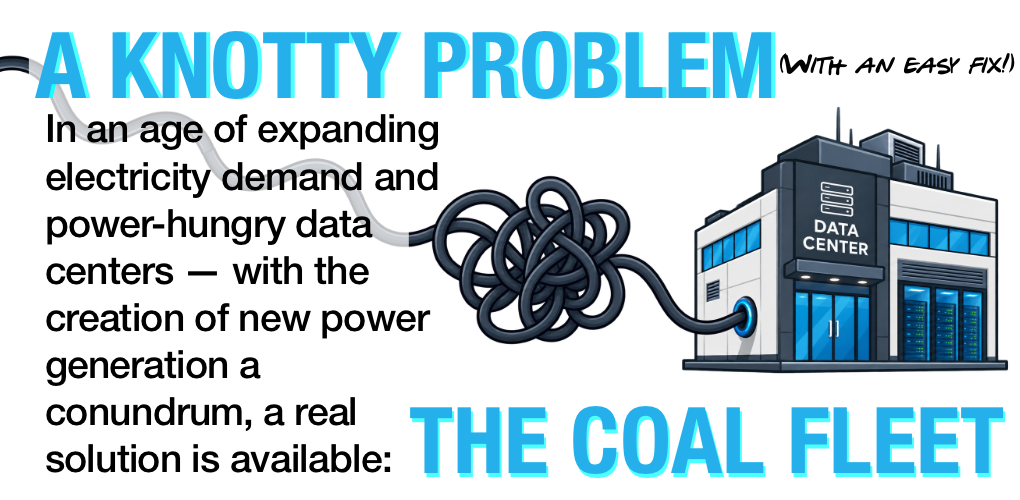
But while we continue to wind ourselves in knots over the new generation conundrum, a real solution is available: the existing coal fleet.
Thankfully the Trump administration recognizes that we have existing megawatts hiding in plain sight in the form of coal plants that are either prematurely retiring or are running at capacity factors well below what they could produce.
Last week, the Department of Energy issued an emergency order to keep the J.H. Campbell plant open through mid-November 2026. The plant was originally scheduled to retire in 2025 but has proven critical to the region’s electricity reliability during periods of peak demand and low generation from intermittent sources of energy.
While critics cite cost concerns over ongoing operations, the question should not be the cost of keeping any one plant open vs. closing that plant. The real calculation is the financial and human cost of the inevitable blackouts that would come with removing well-operating generation before anything is available to reliably replace it, along with the cost of new generation buildout, emergency electricity procurement, and more. When you factor into the equation just how much we need the electricity generated by J.H. Campbell, the cost effectiveness of these emergency orders becomes clear.
This isn’t just an issue unique to the MISO region in the Midwest. PJM Interconnection, which covers the grid serving 13 states and D.C., is scrambling to cover an almost 7 GW deficit for its delivery year 2028.
Keeping existing plants isn’t free—but turning our backs on existing generation and gambling on a grid that is already teetering on the edge of failure is a cost we can’t afford. We’re in a new age of energy demand where we need to stop viewing the coal fleet through the prism of a retirement timeline and start viewing it as an existing reliability asset whose value is only increasing as energy demands rise.
- On August 18, 2026