
Pumping the Brakes on Coal Plant RetirementS
In the wake of the election, with a major pivot on energy and regulatory policy coming in January, utilities are already publicly announcing they’re likely to postpone, or scrap altogether, plans to close coal plants. Utilities desperately need existing capacity as reserve margins shrink and power demand soars.
Southern Company Chief Executive Officer Chris Womack said the utility needs an “all of the above” energy strategy to keep up with demand. “As we look at responding to demand growth, looking at coal operating longer is a consideration,” he said.
Duke Energy Corp. said that if the Trump administration follows through on plans to ax the Biden regulatory agenda, it will reevaluate plans to close coal plants or shift them to run on natural gas. Duke’s Chief Financial Officer Brian Savoy said, in the event of a policy shift, “we’ll see if the dual conversions in Indiana make sense” or if it would be better to keep those units solely coal-burning. He added, “the pace of the energy transition could change.”
A Trend Gaining Momentum
Duke and Southern Company are hardly the first utilities – and certainly won’t be the last – to pump the brakes on coal plant closures. Even before the election, rapidly approaching capacity shortfalls had utilities rethinking or postponing their plans. As S&P Global recently reported, utilities will retire just 3 gigawatts of U.S. coal capacity in 2024, the lowest level since 2015.
Earlier this year, FirstEnergy, one of the nation’s largest regulated utilities, walked back the proposed closure of two of its coal power plants. The decision to continue the operation of the utility’s two West Virginia coal plants past 2030 – the Fort Martin and Harrison power stations – was another clear signal regulatory pressure to push the nation’s coal fleet aside was colliding with on-the-ground reality.
FirstEnergy cited concerns from grid operator PJM Interconnection – the operator of the nation’s largest grid – about a lack of adequate generating capacity in the years ahead for the decision to extend the life of the two plants.
Grid reliability and projected supply shortfalls are exactly what S&P believes is driving the retirement slowdown. “Reliability is threatened because the grid conditions are tightening,” Douglas Giuffre, said executive director of gas, power and renewables analysis at S&P Global Commodity Insights.
And not only is power demand soaring, but utilities are struggling to connect renewable energy and build enabling infrastructure. This is a reoccurring challenge showing little sign of improvement.
Years-long Challenge
In 2022, Bloomberg reported as many as 40 planned coal plant retirements had been postponed or scrapped due to supply chain issues for renewable power or acute grid reliability challenges. And to hear PJM and MISO – grid operators covering nearly half the country tell it – bringing renewable capacity online remains an enormous challenge. Whether it’s supply chain, permitting or financing hurdles, renewable project developers are gaining approval for interconnection but are unable to build and connect projects at the nearly the speed or scale grid operators need.
Earlier this fall, PJM reported that just 2 GW of capacity, nearly all of it solar, had come online in the grid’s service territory this year, down from close to 5 GW in 2023. According to PJM, nearly 450 projects totaling about 37.2 GW in nameplate capacity have signed interconnection agreements but haven’t been built.
For MISO, the grid operator for much of the Midwest, the story is troublingly similar. In June, MISO said that if its members don’t delay retirements of power plants or bring more resources online faster and at larger numbers than they have historically, a potential 2.7 GW deficit in power supply next year could soar to 14 GW in 2029. A deficit of that size is equivalent to the power needed for 10 million homes. Like PJM, MISO has 50 GW of new generating capacity, mostly renewables across 316 projects, that have been approved for connection but are experiencing delays in construction.
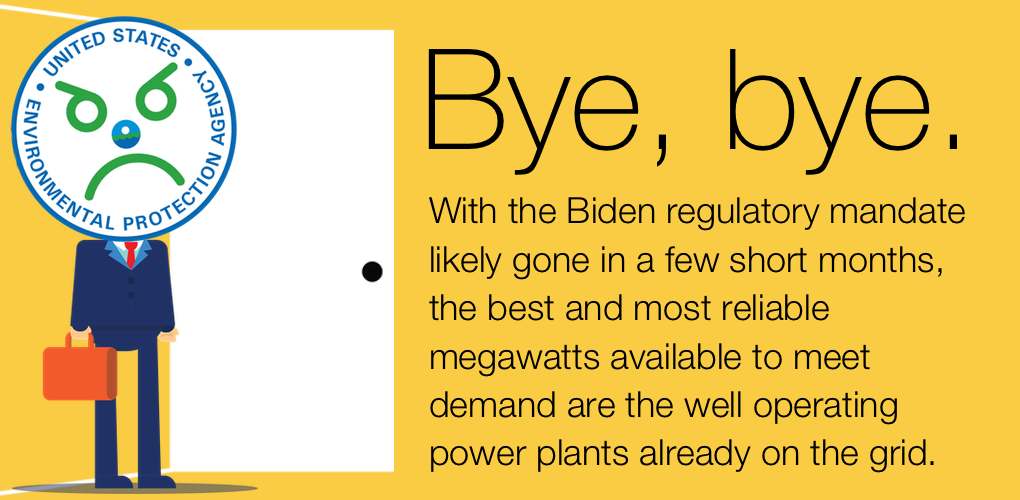
As power demand soars and the challenges to bringing new generating capacity online remain enormous, don’t be surprised to see one utility after another reevaluate their plans for the coal fleet. With the Biden regulatory mandate likely gone in a few short months, the best and most reliable megawatts available to meet demand are the well operating power plants already on the grid.
- On November 13, 2024